


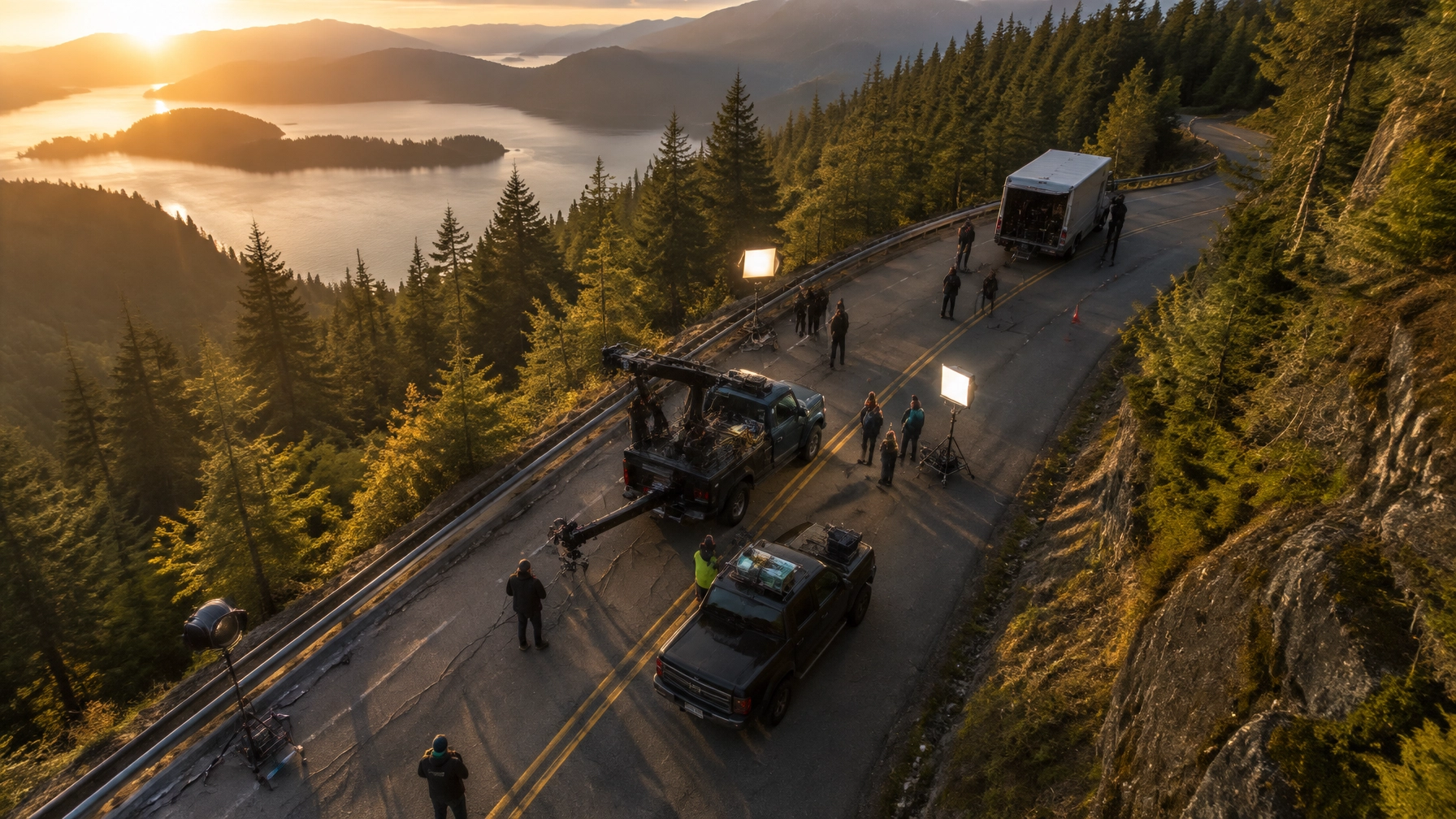
Drone cinematography can give a film or television scene an intimate, moving perspective without putting a camera crew in a helicopter. It can follow an actor from a car to a doorway, circle a figure against a sunset, or hold a long take across a wide landscape. The right shot still depends on the story, the location, and the production’s needs.
I spoke with Rob Miller, Spokane Productions’ studio videographer, cinematographer, and licensed drone pilot. Rob has spent nearly 20 years behind the camera. Here, he explains where drones fit, how he plans moving scenes, and how aerial images reach the final edit.
WHEN A DRONE MAKES SENSE
Producers often have a few ways to achieve a moving aerial shot: a helicopter, a crane, a jib, or a drone. Each has strengths. I asked Rob where a drone can make the biggest difference for a production.
Penny Asked: What can a drone replace on a film or TV set, and where does it make sense to keep the helicopter?
Rob: A drone is a strong option for low-altitude shots that need to feel close to the action. It can follow a person, move around a vehicle, or reveal a location with a controlled camera move. Compared with a helicopter day, it is a fraction of the cost for the right kind of shot. Some setups that used to take hours can now take minutes.
I did at least a half-dozen helicopter captures early in my career. With a drone, I can stand on the ground and operate the aircraft. That is a very different risk profile from hanging out of an open helicopter door with a camera.
That does not mean a drone replaces every aerial platform. Helicopters remain useful for high-speed work, longer flight time, and heavier camera payloads. A crane or jib may be a better choice when a move needs to be repeated precisely or when flying is not practical. The question is not “Which tool is best?” It is “Which tool gets the shot safely, efficiently, and in the style the director wants?”
The Society of Camera Operators’ overview of aerial cinematography also frames drones and helicopters as tools for different jobs, rather than interchangeable options.
DRONE CINEMATOGRAPHY WITH TWO OPERATORS
The drone is only part of the camera system. On a complex shot, dividing flight control and image-making between two people can give a production more flexibility. I asked Rob how that division works with the Inspire 2.
Penny Asked: Why use two operators instead of having one person fly and frame the shot? What does the Inspire 2 bring to the production?
Rob: With dual-operator mode, one person flies the aircraft while the camera operator works the picture. The pilot can concentrate on the flight path, while the camera operator concentrates on framing and movement. That separation supports safer flights and more fluid capture, especially when we are following actors through a planned take.
For cinematic work, the Inspire 2 can carry the X5S camera for up to 5.2K capture or the X7 for up to 6K. Both offer larger sensors than a general-purpose drone camera, and their interchangeable lenses give the cinematographer more options for the image.
That matters when the drone needs to match the camera package already on the production. We talk through the intended look with the director or DP and choose the camera and lens for the shot, not just the biggest specification on paper.


PLANNING A MOVING SCENE
A moving shot is a piece of choreography. The aircraft, camera, talent, vehicles, and crew all need to work together. I asked Rob to describe a few scenes he has captured and what it takes to prepare for one.
Penny Asked: What does it take to fly a scene with an actor or vehicle? Can you share a few examples from your work?
Rob: On a television series, we used a drone for a low-altitude follow. A subject got out of a vehicle, walked to a house, and went inside. The shot needed to travel with the person and feel connected to the action, not like a detached aerial establishing shot.
On another job, an ATV crossed an open prairie. The rider stopped on a hill, stepped off, and looked over the valley in a cowboy hat. The drone made a slow orbit around him as the sunset opened up behind the landscape.
I also worked on a documentary scene with an SUV crossing a desert. The vehicle stopped beside an environmental feature, the scientist got out, and the camera followed as he walked through the location. We captured it as one continuous take.
For a shot like that, I work with the director and DP on blocking, timing, and camera placement. We talk through where talent will move and when the drone should start, turn, or hold. On larger sets, radios let us coordinate with the crew while piloting from a safe position off set. We can also use ND or polarizing filters when the lighting and reflections call for them.

FROM AERIAL CAPTURE TO FINAL CUT
Getting the shot is one part of the job. The footage still needs to fit the scene and reach the right people on time. I asked Rob how Spokane Productions connects the aerial work to the rest of a production.
Penny Asked: How do you get from the flight to footage that feels like it belongs in the film or show?
Rob: We start with a four-step process: scouting, safety and compliance, capturing, and delivery. We plan the location, light, shot needs, hazards, and required permissions before the flight. On set, we coordinate with the director and DP. After capture, we get the footage to the digital imaging technician, or DIT, while the crew is still working. We also keep backups in three locations.
Then we match the aerial footage to the production’s cinema-camera material. The edit is where the full scene comes together: story, pacing, music, narration, effects, and color grading. Spokane Productions can support that work through our video production and post-production services.
Live-event work takes additional planning. If aerial video needs to feed a live production, the team must plan the transmission path, communications, and timing. Broadcast workflows may target sub-500-millisecond end-to-end latency, but the actual result depends on the full signal chain. A dedicated link and a technical test are essential; no single piece of equipment guarantees that latency.

SAFETY, FAA RULES, AND SET READINESS
A cinematic shot still has to be a compliant operation. I asked Rob what producers should verify before hiring a drone pilot.
Penny Asked: What should a production confirm before a commercial drone flight?
Rob: Ask who is flying, what experience they have, and how they will coordinate the flight with the set. Commercial work requires a qualified pilot operating under FAA Part 107. The pilot needs to keep their knowledge current through recurrent training every 24 calendar months. Rob maintains his Part 107 qualifications through biennial recertification.
The aircraft must be registered as required and comply with Remote ID requirements. A flight may also need specific airspace authorization, depending on the location. Registration and a pilot certificate do not automatically clear a flight in every airspace. Productions should also confirm location permissions, film permits, insurance, and the safety plan.
Hiring an unlicensed or unauthorized operator can create legal and financial exposure. FAA civil penalties can reach $27,500 per violation in applicable cases; that is a potential maximum, not an automatic fine for every incident. If a pilot causes damage or injury, the production or client may also face liability depending on the circumstances. Confirm the pilot’s credentials and insurance before the shoot, and coordinate any required permissions in advance. The FAA’s current guidance is available on its pages for commercial Part 107 operators, Remote ID, and keeping a Remote Pilot Certificate current.
BRING AERIAL CINEMATOGRAPHY TO YOUR NEXT PRODUCTION
What scene, location, or story would benefit from an aerial point of view? Contact Spokane Productions to discuss your project, the shot list, and the production support you need. We can help with aerial capture and connect it to the rest of your video workflow.
Our studio is at 5380 E Seltice Way, Suite A, Post Falls, Idaho. We look forward to working with you!


SEO title: Drone Cinematography for Film & TV | Spokane Productions
Slug: drone-cinematography-film-tv
Meta description: See how Spokane Productions uses drone cinematography for film and TV, from dual-operator Inspire 2 shots to safe planning and post-production.
Focus keyphrase: drone cinematography
Categories: Video Production, Cinematography, Film Business
Internal links: Rob Miller’s drone interview, video production, film permits, and contact. The live URLs for drone-series articles 2–5 were not available during drafting; add verified links before publication.