A CHRISTMAS PROGRAM BUILT FOR THE ROOM
A church christmas video production can help connect the planned story of a holiday program with the energy of a live performance. Recently, One* Church in Spokane, WA, used the Spokane Productions studio to produce video. That video will integrate with live performances of its Christmas shows shortly before the holiday.
The idea is straightforward. Create recorded segments that complement the performers and musicians in the room. The video can establish a mood, carry a story, or bridge one part of the program to the next. Then the live choir, band, and drama bring that experience into the shared space of the church.
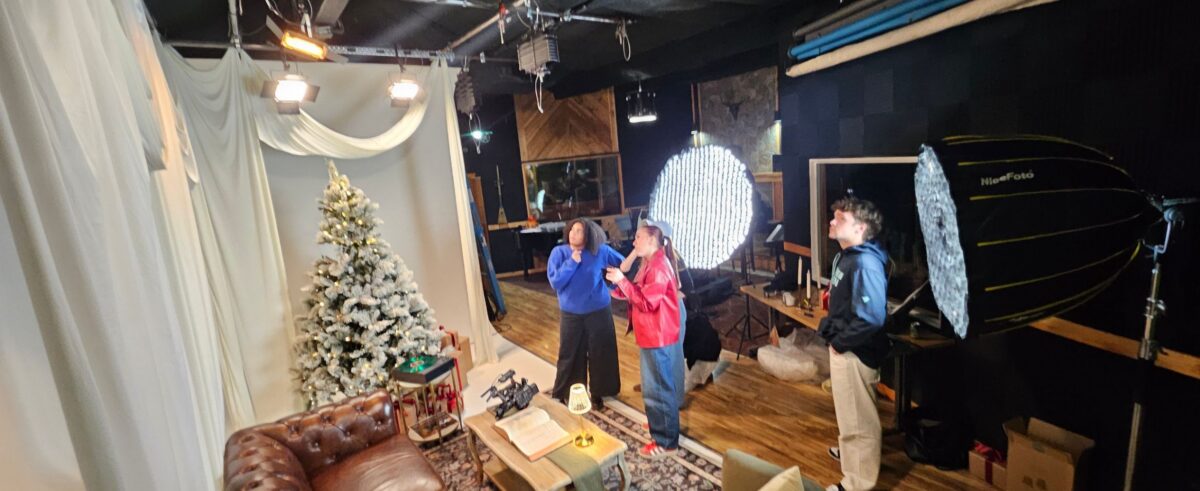
So this project is a behind-the-scenes look at how a studio set can support that kind of production. The images show a Christmas scene being prepared and performed inside a working studio, not a sanctuary stage.
WHY CHOOSE A STUDIO FOR CHURCH CHRISTMAS VIDEO PRODUCTION?
A sanctuary is made for gathering. By contrast, a studio is built to control the details of a recording. For a church preparing a live holiday program, each setting has its purpose.
In a studio, lighting can be shaped around the scene and adjusted between takes. Likewise, audio can be managed for a clean recording. The team can repeat a moment without needing to reset a service or use time during a live gathering. As a result, performers get room to refine a line, a movement, or the timing of a scene before the show nights.
The studio also gives the production team a controlled background. Because of that, it is easier to prepare footage for projection or LED walls, where consistency and legibility matter. A set can be built once, filmed from multiple angles, and reused for different segments. Close-ups are possible, too. They give the audience a more personal view than a camera at the back of a congregation-sized room may provide.
Above all, recording ahead of the event creates time to get the performance right. The team can review, edit, and finish the segments before they become part of the live program.
What does your audience need to see or hear to follow the story and feel part of the moment?
A SET WITH A CLEAR POINT OF VIEW
The Christmas set brings a familiar living-room feeling into the studio. A flocked tree glows beside cream-colored drapery. A tufted leather Chesterfield couch and an armchair create a place for performers to gather. A wooden coffee table holds a large open book and a small lamp. Gift boxes, a patterned rug, and a vintage turntable add detail.
The set is framed by dark studio walls and surrounded by production equipment. Meanwhile, that contrast is part of the story in these behind-the-scenes images: a welcoming seasonal scene, shaped inside a professional production space.
Three performers are on set in front of the tree under direction. Large soft sources help light the scene, including a Godox QR-P120 parabolic softbox. On top of that, a circular LED fixture and an overhead rig provide additional lighting. The team can position and adjust those sources to support the image while keeping the set’s warm, intimate character.
A separate green screen corner is visible nearby. That gives the production team another controlled background option for material that needs a different visual treatment.

FROM RECORDED SCENES TO LIVE MOMENTS
Church Christmas video production is most effective when the recorded material has a clear role in the larger program. It should support what happens on stage, not compete with it.
For example, recorded pieces can serve as opening sequences that welcome the audience into the program. Narrative segments can establish context or move the story forward. Testimony-style pieces can create a quieter, more personal moment. In addition, short transitions can connect scenes, music, and live performance without leaving an awkward gap.
The live choir, band, and drama still carry the room. However, the recorded content gives the team another storytelling tool. It can set up a moment, offer a shift in perspective, or give the audience a closer view before the stage action resumes.
That balance is worth planning early. To be specific, a program may need a single opening video, several short transitions, or a longer narrative segment. The right format depends on the story, the run of show, and how the live team wants to use the screen.

PICTURE AND SOUND NEED TO WORK TOGETHER
Video carries more than images. After all, sound affects how the audience understands a scene, follows a transition, and experiences the program as a whole.
A studio can provide a controlled place to record clean vocals and instruments. From there, those recordings can be edited and mixed into finished playback for the church to run on show night. The goal is a dependable delivery that fits the program and is ready for the church’s playback setup.
Synchronization matters, too. A video segment, soundtrack, slide, and live cue all need to land together. Planning the sequence ahead of time helps the production team prepare files and timing that suit the event. In turn, it gives church staff a chance to review how recorded material will meet the live elements.
The production approach can scale to the project. Depending on the need, that may mean creating only the video segments, recording audio separately, or coordinating picture and sound through a more complete production process. Each choice should serve the program’s needs.
CAPTURE THROUGH POST-PRODUCTION
A successful studio shoot is only one part of the work. Even so, the material must be shaped into a final piece that feels clear, consistent, and ready to use.
Spokane Productions can handle the project from capture through post-production. That includes editing, color, sound, and delivery. Keeping those steps connected carries the original plan into the finished content. It also reduces the burden on a church team already preparing for a busy season.
If your team has its own production plan, studio rental offers a space to build and capture the material. If you need support beyond the room, explore video production services for help with the production process.

PLAN YOUR CHRISTMAS PROGRAM CONTENT
Start with the audience experience. First, what should people understand before the live performance begins? Where could a recorded scene add a useful pause, a personal connection, or a transition? Also ask which parts of the story belong on screen, and which are strongest when performed live?
Those questions help define the scope. They also help determine how much recording time is needed and what the set should communicate. And they settle whether the program calls for video, audio, or both.
You can begin with one focused piece, or instead build a series of segments for a larger event. That way, the production can be planned around your content, your schedule, and the way your church will present the finished material. What would make your Christmas program more meaningful for the people in the room?
LET’S MAKE YOUR CHRISTMAS PROGRAM
Spokane Productions works with clients on projects of different sizes, from studio access to complete production support. Are you preparing a Christmas program, pageant, show, or seasonal event? We would be glad to talk through what you need and how recorded content can support the live experience.
Contact Spokane Productions to start a conversation about your project. We look forward to working with you!
