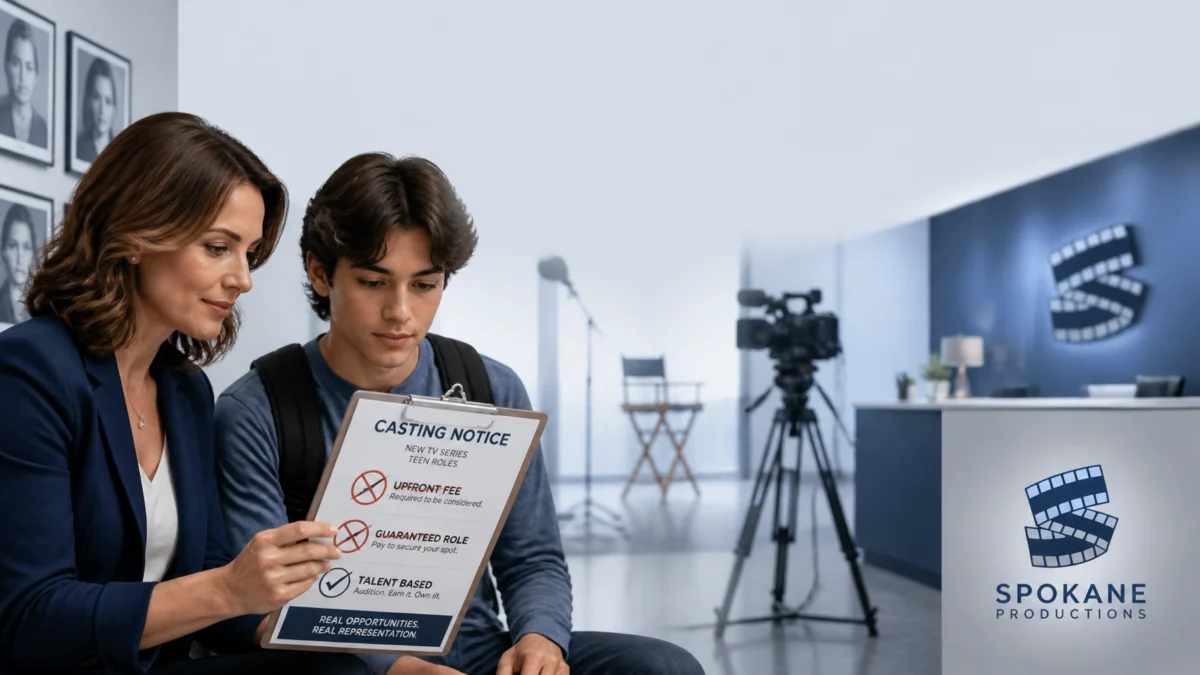
Some opportunities are real. Some are just well-packaged sales funnels.
Recently, our studio heard from friends who responded to an ad marketed as “an audition for several film and television roles locally” and an “open casting call.” It looked legitimate at first glance. It sounded like a quick, local shot for young performers, especially kids, and their parents.
What they walked into was something else.
They entered a room with roughly 100–150 hopefuls. Two desks at the front. A quick “audition” experience. One line to read. A short walk across the room. Minimal interaction. No real direction. No time. No context about actual productions.
Then came the fork in the road.
Some performers were told they might go straight to the “Artist Agency.” Others would be routed to the “Development Agency.”
Here’s the part that matters: we’re not aware of anyone who made it to the “Artist Agency.” Everyone who received a callback, from what we could tell, was contacted for the “Development” side, which was essentially paid training and classes.
Mostly online. Video-conference based. Group format. Unclear instructor-to-student ratios. Pricing from $29/month all the way up to thousands of dollars, depending on what the performer “qualified for.”
If that feels like a bait-and-switch, you’re not alone.
This post isn’t here to name names. It’s here to protect your time, your money, and your momentum.
WHAT THIS KIND OF “OPEN CALL” IS REALLY SELLING
Let’s be direct.
A legitimate casting process is designed to cast a project.
A pay-to-play funnel is designed to sell a program.
Those can look similar on the surface. Especially to newcomers. Especially to parents trying to do the right thing for a motivated kid. Especially when the ad uses the right words: casting, roles, agency, audition, callback.
The difference shows up in what happens next:
- If the “callback” is really a sales call, that’s not casting.
- If “development” means “pay us monthly to learn how to get an agent,” that’s not representation.
- If the main product is classes, sold right after an “audition”, you’re not in an audition pipeline. You’re in a lead pipeline.
And when the audience is children and parents, the emotional pressure can be intense.
THE NON-NEGOTIABLE RULE: NEVER PAY AN AGENT UP FRONT
Here’s Spokane Productions’ friendly studio advice, in plain English:
Never pay an agent for representation. Period.
A real agent earns money when you earn money. They take a commission from your booked work. If you don’t book, they don’t get paid.
This isn’t just “industry folklore.” The U.S. Federal Trade Commission says it clearly in their consumer guidance on modeling/talent scams: “Never pay an agency up front. Any agency asking you for money to represent you is a scam.”
Source: FTC – Modeling Scams
https://consumer.ftc.gov/articles/modeling-scams
WHAT LEGIT REPRESENTATION LOOKS LIKE (IN REAL LIFE)
Legitimate agents:
- Do not charge audition fees.
- Do not charge “registration” fees to be represented.
- Do not promise you’ll book.
- Do not guarantee fame, salaries, or roles.
- Do not rush you into signing.
- Do not require you to buy their headshots, their classes, or their demo package as a condition of being represented.
They evaluate whether they can market you. Then they submit you for roles. Then, if you book, they earn a commission.
Simple. Transparent. Results-based.

PAY-TO-PLAY RED FLAGS YOU CAN SPOT FAST
If you take nothing else from this post, take this checklist.
RED FLAG #1: “YOU HAVE TO PAY TO AUDITION”
Casting doesn’t work that way.
RED FLAG #2: “YOU QUALIFIED FOR OUR DEVELOPMENT PROGRAM”
Be careful with “qualification” language. Sometimes it’s a sales tactic. Everyone “qualifies” for a payment plan.
RED FLAG #3: THE “AUDITION” IS A MASS CATTLE CALL WITH NO REAL EVALUATION
Yes, open calls can be busy. But if it’s 100+ people, minimal time, no project details, and then a pitch for classes… you’re not being cast. You’re being processed.
RED FLAG #4: GUARANTEED WORK, GUARANTEED INCOME, GUARANTEED REPRESENTATION
The FTC calls out “guarantees” as a major warning sign. There are no guarantees in this business.
https://consumer.ftc.gov/articles/modeling-scams
RED FLAG #5: PRESSURE TO SIGN TODAY
“If it’s good today, it should be good tomorrow.” That’s also FTC advice.
https://consumer.ftc.gov/articles/modeling-scams
RED FLAG #6: THEY REQUIRE THEIR OWN PHOTOGRAPHER OR “MANDATORY” PACKAGES
A suggestion is one thing. A requirement is another. The FTC explicitly warns about being forced to use in-house photographers or services.
https://consumer.ftc.gov/articles/modeling-scams
RED FLAG #7: VAGUE DETAILS ABOUT THE ACTUAL ROLES
What production? What casting office? What director? What dates? What pay rate? Where will it be filmed? Who is the employer?
If answers are fuzzy, that’s information you’re being kept from on purpose.
RED FLAG #8: THEIR BUSINESS MODEL IS YOUR MONTHLY PAYMENT
If the company primarily makes money from performers (not productions), your “career” may just be their subscription revenue.

“BUT ARE CLASSES ALWAYS A SCAM?” NO. HERE’S THE REAL DISTINCTION.
Training is real. Coaching is valuable. Studios and teachers can be worth every dollar.
The issue is how it’s sold and what it’s tied to.
A legit class says:
- “Here’s what we teach.”
- “Here’s the instructor.”
- “Here’s the schedule.”
- “Here’s the student-to-teacher setup.”
- “Here’s the cost.”
- “Here are outcomes we can’t guarantee, but skills we can build.”
A scammy funnel says:
- “You’re being considered for roles.”
- “You did great.”
- “You qualify.”
- “Pay now to continue.”
Same product (education). Different packaging (manipulation).
If “classes” are positioned as a toll booth between you and representation, that’s the problem.
WHAT TO DO INSTEAD: A CLEAN, PROFESSIONAL PATH TO REPRESENTATION
You don’t need a secret program. You need fundamentals. You need proof of work. You need a clear package. You need smart outreach.
Here’s what we recommend.
1) BUILD A SIMPLE, HONEST PERFORMANCE RESUME
Start where you are.
- Community theater credits count.
- Student films count.
- Voice samples count.
- On-camera practice counts.
- Training counts (real training, not “paywall training”).
Keep it readable. Keep it current. One page is fine.
2) GET HEADSHOTS THAT MATCH THE MARKET YOU’RE PURSUING
You don’t need ten looks. You need one great, truthful shot.
Also: especially for kids: be cautious about anyone insisting you must buy a big, expensive portfolio immediately. The FTC even notes that for child performers, legitimate decision-makers often ask for casual snapshots because kids change quickly.
https://consumer.ftc.gov/articles/modeling-scams
3) CREATE A DEMO REEL OR VOICE DEMO THAT’S SHORT AND PROFESSIONAL
If you’re going for:
- On-camera: keep clips short, clean, and performance-forward.
- Voice: focus on clarity, variety, and audio quality.
This is one area we do know well at Spokane Productions. If you need clean audio recording, voice-over capture, or post production, we’re built for that. Small session. Full production. Your call.
4) LEARN HOW SUBMISSIONS WORK (WITHOUT PAYING SOMEONE FOR “SECRET ACCESS”)
You can reach out professionally without being tricked into paying for “the list.”
Over the next couple of weeks, we’ll publish more guidance on:
- how to contact agents,
- what to send,
- what not to send,
- what a real conversation looks like,
- and how to evaluate representation offers.
First and foremost: don’t pay for that info. It’s free.
5) VERIFY BEFORE YOU COMMIT
Do basic diligence before you show up, sign, or pay.
The FTC recommends researching the company name with terms like “scam,” “review,” “complaint.”
https://consumer.ftc.gov/articles/modeling-scams
Also:
- Ask for details in writing.
- Ask for references.
- Ask who they’ve placed and where.
- Ask who specifically will teach the class and what the structure is.
If they get defensive when you ask business questions, that’s a signal.
QUESTIONS YOU SHOULD ASK AT ANY “OPEN CALL”
Bring these with you. Use them calmly. A legit organization will answer.
- What specific project(s) is this casting for?
- Who is the casting director / casting office?
- Who is producing the project?
- Is this paid work? If so, what rate and what usage?
- Is there any fee required to audition, be submitted, or be represented?
- If training is offered, is it optional: and who teaches it?
- Can I take any agreement home before signing?
- Can you share verifiable credits of recent bookings for your clients?
If the answers slide back to “development packages,” you’ve learned what the event is really for.
WHERE SPOKANE PRODUCTIONS FITS IN (AND WHERE WE DON’T)
We’re a production studio. We’re not a talent agency.
But we work with creators, performers, marketers, and media professionals every day. We care about clean process. We care about honest expectations. And we hate seeing people get taken advantage of: especially families.
Here’s what we can do:
- Record professional voice demos
- Capture audition tapes / self-tapes with clean lighting and audio
- Help produce intro videos, reels, and polished content
- Provide studio rental for creators who need a controlled space
- Handle post-production so your material looks and sounds credible
- Create professional head shots, usually less expensive and better quality than the “agency” photos.
Here’s what we won’t do:
- Sell you “access” to agents
- Charge you to “qualify”
- Promise you roles
Because nobody credible can promise that.

IF YOU THINK YOU RAN INTO A SCAM
If you paid and now regret it, act quickly. The FTC provides guidance on reporting and next steps, including reporting to:
https://reportfraud.ftc.gov/
Also consider:
- documenting everything (emails, receipts, names, dates),
- contacting your bank/card provider if payments were recent,
- and warning your local community so fewer people get pulled in.
WHAT ARE YOU TRYING TO BOOK THIS YEAR?
A local commercial? Theater? A first voice-over gig? A student film? A corporate narration? A podcast role?
Tell us what you’re aiming for; and what you already have (or don’t have) in place.
We’ll point you toward a practical next step. No upsell games. Just clear options.
We look forward to working with you.
Contact Spokane Productions: https://spokaneproductions.com/#contact