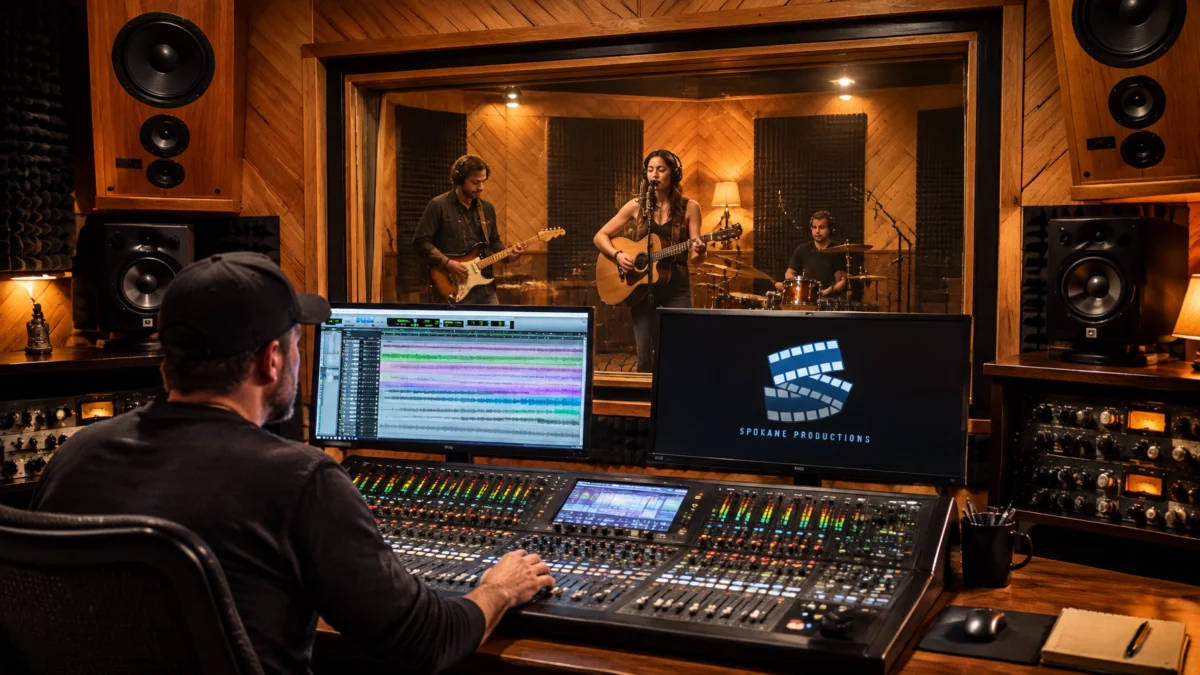
By PENNY MARBEL, interviewing JP, Studio Consultant for Spokane Productions
Published September 26, 2026
Walking into a recording studio is exciting. It can also expose every unfinished decision in a song, arrangement, or performance.
JP, Studio Consultant at Spokane Productions, has watched artists arrive with polished material and clear goals. He has also seen talented musicians lose time and money because they were not ready for the pressure and scrutiny of a professional studio session.
In this interview, JP explains how to prepare for a recording studio session, from defining the project to bringing charts, practicing with a click track, managing a budget, and creating the right collaborative environment.
JP’S PRE-SESSION CHECKLIST
Before booking a music recording studio, ask yourself:
- Is the goal of the project clear?
- Is the budget realistic?
- Are the songs fully rehearsed?
- Are the arrangements settled?
- Does everyone know their role?
- Are the band, instruments, strings, sticks, cables, and accessories ready?
- Are charts, notes, lyrics, and track details written down?
- Do you have sheet music or lead sheets where needed?
- Have you practiced with a click track or metronome?
- Have you talked with a studio consultant about the project?
A short preparation conversation can prevent expensive decisions once the session begins.

THE INTERVIEW
Q1: WHAT MAKES A SESSION RUN SMOOTHLY?
PENNY MARBEL: You’ve watched a lot of artists walk through the studio doors. What’s the difference between a session that runs smooth and one that fights you the whole way?
JP: The difference between a good session and a poor one is preparation BEFORE you get to the studio.
Studios start billing either at the time someone walks into the studio or maybe as late as 30 minutes after they get in the door. What this means is each minute you spend looking for music, or discussing with your drummer how you want an intro, those turn into expensive minutes.
Know your material, have a plan, rehearse, and discuss it with the studio rep BEFORE you walk in the door. If you are an artist or band with a producer, they should know this. If they don’t, then talk with the studio.
Those who have record labels supporting their session will demand the artist or band run with a budget, a producer, and coordinate with the studio. Some artists don’t have to worry about how much time they spend in the studio because someone else is paying for it, or the label has a way of recouping the costs. But most artists have to think about budget.
And the only way to meet budget is to be prepared.
“The meter starts running the moment the door opens.”
JP
Q2: HOW DO YOU KNOW IF YOU’RE READY TO RECORD?
PENNY MARBEL: You named the question yourself, and it’s the one every artist asks. How do I assess whether I’m ready to go into the studio with my music?
JP: Whether or not you go into the studio depends on a lot of factors.
First, know what you have to work with in terms of budget. Second, have your material down pat. Have a solid idea, or goal, of how you want things to sound. Have your preparation down. Know exactly who does what.
But the biggest thing before deciding to go into the studio is define clearly, “What is my goal with this effort?”
Is this for a demo? Are you trying to sell songs? Is this your second album and it needs to be done by mid-June to keep the label happy?
Without a clear goal, NEVER go into the studio, it’s wasted money.
“Without a clear goal, NEVER go into the studio, it’s wasted money.”
JP
Q3: HOW LONG SHOULD YOU PREPARE?
PENNY MARBEL: Once someone’s answered that and they’re ready. How much time should they give themselves before the session? What does the runway actually look like?
JP: Time in prep is determined by the nature of the project.
Even simple demos can take a week in prep. The bigger and grander the vision, the more time it needs. I’ve seen some people take a year to prep.
Very commonly, we get calls two or three months before the scheduled session where the artist is getting ready.
Q4: HOW MANY SONGS SHOULD AN ARTIST BRING?
PENNY MARBEL: Songs versus catalog. Should an artist bring everything they’ve written, or walk in with a specific set of songs? How do you help them choose?
JP: That’s a simple one. Keep the scope simple until a bigger scope is needed.
For example, if you plan on doing an album, bring in just the 10–15 songs and plan to take the appropriate amount of time for each song. Across history, some special songs have taken months and even years to get to a point where they can be released. In other cases, the artist came in and 15 minutes later there was a number one hit.
It’s usually very difficult to do two tracks a day for an album. Conversely, for demos, we have successfully recorded 10–15 in a three-hour session. The artist was recording a demo for his gig act, and he just sat down and ripped them out.
Quality of the tracks is also a factor. The better tracks normally take a longer time. Not always, but usually quality takes time.
So, keep your scope narrow and focused.

Q5: HOW FINAL SHOULD THE ARRANGEMENTS BE?
PENNY MARBEL: Arrangements. How final do the songs need to be before the red light comes on, and what changes are still okay to make once you’re in the room?
JP: Big-name bands often own their own studio to rehearse and develop songs in. Subsequently, their arrangements have a tendency to be more polished once they come in.
This is a place where the delicate balance between true creativity, professionalism, and innovation also needs to be tended to.
Creativity in the studio can come from careful planning and practice, and that’s usually and far and away the case. Occasionally, there is a place where some accident or thought comes in when the artist is in the studio.
Quincy Jones, the great producer, said this: “If you take your music from charcoal to watercolors to oil, you leave room for creativity. One of my favorite sayings is, ‘Let’s always leave some space for God to walk through the room.’”
But he’s also notorious for having the arrangement nailed before he walks into the control room.
Have everything ready. Then, if the situation is right, change the plan only after careful consideration. Occasionally it’s ok to mess around in the studio and see if the plan needs tweaking.
Q6: WHAT SHOULD ARTISTS BRING?
PENNY MARBEL: What should an artist bring to the studio, and just as importantly, what should they leave at home?
JP: First, leave the attitude at home.
A lot of mediocre artists have an attitude that makes the collaborative effort of putting music into a product people want to consume a long and aggravating process.
The most beloved artists are also those that are easy to get along with and realize that although they are the star, it takes a team to bring their talent and performance to the public.
Bring a good attitude and pleasant demeanor to the studio.
Next, make sure your gear is good. Have all the strings, sticks, cables, and cords you need. Make sure you have your band with you and ready.
Make sure you have charts, notes, and details of the tracks in writing. Bring samples of songs you recorded on your phone when you woke up in the middle of the night.
All that is resource material needed in the session.
“Leave the attitude at home.”
JP
Q7, CAN A BAND OVER-REHEARSE?
PENNY MARBEL: Rehearsal. Is it possible to over-rehearse, or is there no such thing? What do you actually want to hear from a band before they book?
JP: Rehearsal is key.
We always tell, or always ask, artists that are trying to book time, “How prepared are you?” or “Does your band have all the songs down and ready to do this?”
I personally like to hear, “We have been playing these songs for a couple months now.”
That helps a lot.
Q8, WHAT ABOUT A SOLO SINGER-SONGWRITER?
PENNY MARBEL: For the solo singer-songwriter with a guitar and no band. What’s the smart path into the studio? Where do they start?
JP: Same place as everyone else: preparation.
But for the songwriter side of their career, register your songs and get them copyrighted before you record them.
Next is documentation. We run into artists all the time that can’t actually write music. The best they can do is some words with chords penciled in on top of the lyrics.
First, you CAN get real music charts with services that are online. Just dump a copy of your song in there and what pops out is sheet music. There are some tools out there, too, that will take your recorded music apart and do that (create sheet music) , too.
There are all sorts of ways to get real sheet music without actually having to write the music yourself.
Next, practice playing to a click track, especially if you have the tendency to change the tempo of your music while you play it. Buy a cheap metronome and practice to it.
Depending on how you create, you may want to bring a friend you work with to give you another opinion of how your tracks are sounding and not just the input of the engineer.
Finally, talk with a studio consultant. Most studios won’t charge for this, and they will take some time to discuss your project and give you good next steps.
Finally, think about budget.
BUDGET, PRESSURE, AND THE DETAILS THE STUDIO REVEALS
Q9, WHAT DO ARTISTS GET WRONG ABOUT COST?
PENNY MARBEL: Money and mindset. What do artists most often get wrong about budget, time, and the pressure they put on themselves once they’re paying by the hour?
JP: The first and foremost thing we see at the studio is that artists don’t prepare enough and they don’t have everything worked out before they come in.
This drives up cost more than anything.
The other thing is they don’t realize that without a clear vision of the end project, they will run up costs because they “wander” through the creative decisions they need to make.
A clear vision of the finished product is incredibly important as well as prep.
Also, just because your band can play the song great and the rehearsal is done in 20 minutes in the warehouse they practice in, when it comes to the scrutiny of the track by an engineer, a click track, and a tuner, you see all the warts come out of the song and performance.
Songs with complex tracking also consume time. If your vision is complex, it’s usually time-costly.
When things in the studio start to turn bad because of band members’ frustrations, changes in plans, or other negative influences, we see the time cost go up and the quality of the track go down. Keep peace in the studio.
There is a lot more scrutiny of the music in the studio. It sounds different in the studio.
Finally, don’t put yourself under pressure unless you work better that way. Pressure often causes bad decisions, frustration, and ultimately a bad track.
Learn to take breaks when it feels right. And if it doesn’t feel right, maybe that’s an indicator that it’s time to take that break.
“You see all the warts come out of the song and performance.”
JP
Q10: WHAT MAKES A SESSION TRANSFORMATIVE?
PENNY MARBEL: Last one, and it’s the big one. What separates a good recording session from one that changes an artist’s trajectory? What do you want every person who books with Spokane Productions to walk out knowing?
JP: First, you have to keep in mind that if the artist is successful and satisfied with the interaction with the studio, the studio ultimately benefits.
So everyone in a good studio wants to do everything they can to support the artist, create a great product, and make the sessions productive, pleasant, and something the artist looks forward to. Everyone in a great studio is invested in the process, the artist, and the outcomes.
A great session has a great producer, quality players, great material to record, and the studio provides all the tools to facilitate those creative environments.
A great session is done in a place where the artist feels it’s right and knows it’s moving in the right direction.
Great engineers, good equipment, and a place where the creative process can unfold is what a session or studio should provide.
As far as Spokane Productions goes, we value highly our artists that book with us. From those just starting out to those pros that know exactly what they are doing, we look for how we can help their career arc, and we try to take their music as seriously as they do.
PREPARE WITH PURPOSE
A successful studio session starts before the first microphone is placed.
Define the goal. Prepare the songs. Rehearse the arrangements. Practice with a click track if the music needs a steady tempo. Bring charts, sheet music, notes, and backup materials. Know the budget. Leave room for creativity, but do not use expensive studio time to discover the basic plan.
Spokane Productions offers flexible options for artists who need a professional recording environment, experienced engineering, studio rental, mixing, mastering, and broader production support. Explore the Spokane Productions studio, review audio recording services, or learn more about studio rental options.

Ready to discuss your songs, timeline, and budget?
Contact Spokane Productions to schedule a free consultation. We look forward to working with you.
