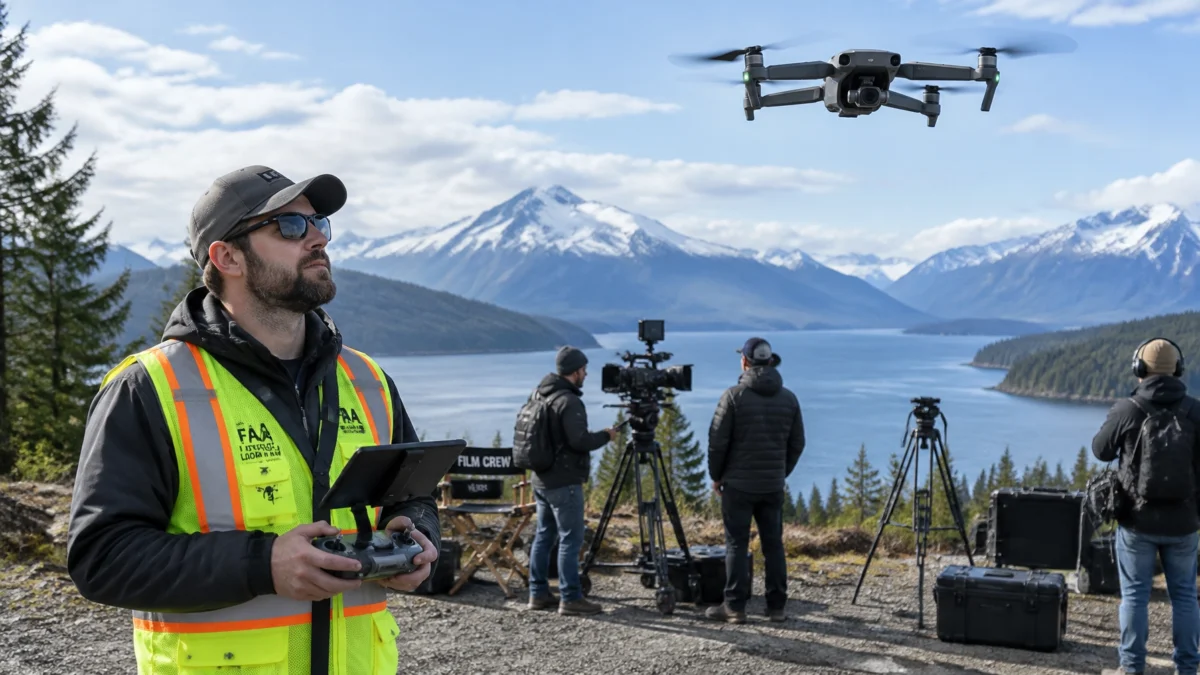
By Penny Marbel | Interviewing Rob Miller, studio videographer, cinematographer and licensed drone pilot at Spokane Productions
Draft for jp's review — not for publication.
What can professional drone services do for your project? A drone can give you a new point of view, document a property, capture a moving scene, or reach a rugged location that would be difficult to film from the ground. At Spokane Productions, Rob Miller brings nearly 20 years of camera experience to the work, combining cinematography with licensed drone operation.
In this interview, Rob explains how he chooses equipment, prepares for a flight, and uses aerial footage across different industries. This conversation launches our series on drone services at Spokane Productions: from real estate flyovers and mapping to inspections, agriculture, events and film production.
PROFESSIONAL DRONE SERVICES: THE INTERVIEW
GEAR AND LICENSING
Every conversation about drone services starts with the same question from clients: what do you actually fly? How Rob answered it says a lot about how Spokane Productions thinks — one tier of aircraft for the everyday work, another for the cinematic job.
Penny Asked: First things first — what are you flying, and what is each drone actually for?
Rob:
We upgrade equipment regularly, but currently we have two tiers of drones, depending on the project: the Mavic 2 Pro and the Inspire 2.
The Mavic series is a great general-purpose aircraft for film establishing shots and b-roll, construction, engineering, inspections, photogrammetry and mapping, search and rescue, and real estate photography and video.
The Inspire 2 can be used in dual-operator mode for cinematic shots in films, commercials and documentaries. It captures higher-quality video, up to 5.2K with the X5S camera or 6K with the X7 camera. Both cameras have larger image sensors than the Mavic series and feature interchangeable lenses.
With dual-op, the pilot in command can focus entirely on flying while the camera operator works exclusively on the picture. Splitting those roles allows for a safer flight and more fluid video capture, especially when following an actor during advanced takes.
Flying a drone looks simple from the ground. The paperwork behind it is not. Before we talked gear, I wanted to understand what it legally takes to put an aircraft in the air for a paying client — because most people hiring drone work have no idea.
Penny Asked: Walk us through it. What does it legally take to become a commercial drone pilot in 2026 — the certificate, the tests, the registrations, the airspace approvals?
Rob:
FAA Part 107 regulations went into effect on August 29, 2016. Anyone operating a drone commercially needs the proper certification and must follow the applicable rules for safe, legal operation. I passed the Part 107 test the first day it was offered, and I recertify every two years to keep my license current.
The pilot needs a current remote pilot certificate. The aircraft must be registered as required, broadcast Remote ID as applicable, and be maintained in safe operating condition. Before each flight, the pilot needs to understand the airspace and have any required operational approval.
That includes knowing the operating limits, airspace restrictions, and when approval or communication with the FAA or air traffic control is necessary. Rob’s full breakdown lives in our drone FAQ.
Big-box stores sell capable drones for a few hundred dollars, which raises an obvious question for anyone shopping for aerial work: why not just find the guy with the drone? I put it to Rob straight.
Penny Asked: Anyone can buy a drone at a big-box store. What actually separates a licensed professional from a hobbyist with a nice aircraft — and what does a client risk by hiring the hobbyist?
Rob:
Drones can be flown recreationally, and they are a fun way to see the world from the air. But when a flight is tied to revenue, it is considered commercial and Part 107 rules apply. That can include a roofing company documenting a project, a realtor marketing a home, a filmmaker capturing establishing shots, or an influencer creating monetized content.
The FAA can enforce civil and criminal penalties for noncompliance. Civil penalties can reach $27,500 per violation, with criminal exposure of up to $250,000 and/or imprisonment for up to three years in applicable cases. It is worth putting in the effort to get licensed and follow the rules.
Insurance for the drone business and equipment is also highly advisable. Hobbyists and unlicensed operators often do not have it. The commissioning party may also face liability for the actions of an unlicensed pilot it hires, especially if an incident occurs.
WHO USES DRONE SERVICES, AND WHY
I asked Rob to run down the industries he has actually flown for, expecting a tidy three-item answer. He read me a list that took a while — and it kept going.
Penny Asked: Drones show up in a lot of industries now. Walk us through the ones you work with — who is actually hiring drones?
Rob:
We have been hired for public events, real estate, photogrammetry and mapping, architecture, higher education, roofing documentation, construction, engineering, agriculture, radon remediation, landlord evictions, property-boundary disputes, damage documentation, bridge inspections, flooding, homebuilder projects, products, commercials, advertising, filmmaking, documentaries, and general photography and video.
Drones are versatile and smooth. They can even replace ground cameras for some moving scenes.
Firefighting agencies usually have their own drone departments, so we do not fly when there are wildfires. A drone can ground manned aircraft and cause extreme delays, increasing property damage. It is not worth the risk. Some operators still do it, but knowing when not to fly is part of being a professional.
Search-and-rescue and law-enforcement agencies often have their own programs. We are always ready to assist if there is a need for our services.
The Northwest is mountains, lakes, forests and city — gorgeous, and often unfilmable from the ground. Rob's aerial drone services specialty lives right in the middle of that problem.
Penny Asked: Broadly speaking, what can a drone give a project that a camera crew on the ground simply cannot — especially in this geography?
Rob:
One of my specialties is remote or rugged terrain. We have camped overnight to get a sunrise shot for a client. Off-roading on washed-out dirt trails is a regular part of my work. We have used ATVs to reach locations where another pilot could not get to the site by vehicle.
Once the drone is in the air, the views in these locations are breathtaking. We have been privileged to see some of the most amazing places in the Northwest. The incredible views from the air are just not possible from the ground with a tripod.
It is the same in the city. A drone has accessed rooftops, skyscrapers and cityscapes that hiring a helicopter could not even capture.

Producers and creators are cost-conscious, and Rob spent his early career hanging out of helicopters to get the same kind of shots. I asked him to make the economic case for the drone.
Penny Asked: Make the economic case. What does a drone replace, what does it save, and why is the spend worth it?
Rob:
After performing at least a half-dozen captures from a helicopter early in my career, the appeal of the drone is clear. It’s a fraction of the cost to operate a UAS, and certainly safer to be standing on the ground running the sticks as opposed to hanging out the open door of a helicopter with a camera.
“What used to take hours can now be captured in minutes.”
In addition to the cost savings, clients hire us for the skill and experience of the operator. We have been behind the camera for nearly 20 years. Having a flying camera allows us to capture spectacular images and video from the air, even at low altitude.
HOW SPOKANE PRODUCTIONS PUTS DRONES TO WORK
Of course, the question I most wanted answered was what this looks like inside our own operation. Rob walked me through recent jobs, and his stories were the best part of the conversation.
Penny Asked: How do we actually use drones here at Spokane Productions — what kinds of jobs have you flown, and how does the aerial footage plug into the rest of what we do: editing, color, the studio?
Rob:
Drones are an integral part of our production services. They do not completely replace traditional video capture, but they are incredibly versatile for many types of shots.
On a recent television series, we used a drone at low altitude to follow a subject exiting a vehicle, walking up to a residential house, and entering the front door. Another project followed an ATV crossing an open prairie. The subject parked on a hill, stepped out, and looked over the valley in his cowboy hat while the drone slowly orbited him, revealing the sunset below.
One of my early documentary projects followed a scientist in an SUV across a desert landscape. The camera moved in as he stopped at an impressive environmental feature, exited the vehicle, and walked through it. All in one unbroken scene.
Once the drone media is captured, we match it to footage from the cinema cameras so the production feels coherent to the audience. In post, we bring together story, pacing, scenes, music, narration, effects and color grading to prepare the final product for distribution.

For a client who has never booked aerial work, shoot day is a mystery. Rob broke down the process his team follows on every project, from the first scout to the final handoff.
Penny Asked: Set expectations for us. How do you prepare, how long does it take, what can go wrong with weather or airspace, and how long is the footage alive before it's in the edit?
Rob:
We use a four-step process: scouting, safety and compliance, capturing, and delivery.
Whenever possible, we visit early to scout the site. That lets us plan the flight, document the time of day and sunlight, and work out how to complete the project efficiently and safely. The earlier we can begin planning, the better. Some urban areas near airports require special permission that can take 30–60 days. Most airspace authorization requests can be submitted and approved within minutes.
Once we confirm the flight can be completed safely, we capture the footage. For smaller projects, we communicate directly with the client on site or sometimes operate solo. For larger productions, we work with the director and/or director of photography on talent blocking, scene timing and camera placement. We often use radios so we can fly from a safe location off set. Battery and card changes are relayed quickly to the film crew to avoid wasting flight time or missing a moment.
When we wrap, we arrange delivery of the footage to the digital information technician while still on set. If we are editing the production, we back it up in at least three locations until post-processing is complete.
ROB’S SHOOT-DAY PLAYBOOK
- Scouting: Review the site, timing and light.
- Safety & Compliance: Check hazards, paperwork and airspace.
- Capturing: Coordinate the flight with the project and crew.
- Delivery: Transfer and securely back up the footage.
I noticed Rob had quietly folded his entire safety philosophy into his shoot-day answer, so I circled back. The difference between a professional and a hobbyist usually lives in the details nobody sees.
Penny Asked: A lot of that safety discipline lived inside your walkthrough. What does a professional operation do that a hobbyist never thinks about — people, property, airspace, batteries?
Rob:
Safety is part of the whole process. We look for hazards to people and the aircraft, including aviation and vehicle traffic, trees, power lines, cell and radio towers, military broadcast communications, temporary flight restrictions, military operation areas, unstable landscapes, wildlife, high winds and adverse weather.
We complete the technical paperwork required for the flight, which may include airspace authorizations, operational waivers and flight records. Batteries work best at moderate temperatures, so we keep them cool in summer and warm in winter. We physically inspect the aircraft before takeoff.
And we do not fly during wildfires. Unauthorized drone flights can ground manned firefighting aircraft and delay their response. That can increase damage to property. Some operators still take that risk. We do not.
THE ROAD AHEAD
I closed by asking Rob to look ahead — where the industry is going, and what a creator reading this should know before they hire anyone.
Penny Asked: Where is all of this heading in the next few years, and what should clients be asking a drone provider right now?
Rob:
Drone technology is improving rapidly. In the last decade, drones have gone from slow, unreliable flying machines with short battery life to advanced flying computers with incredible technology built in.
We already see subject tracking, obstacle avoidance, automatic following, hyperlapse footage, 3D image capture, ultra-high-resolution video, focal-length changes without swapping lenses, thermal imaging, and more than double the battery life.
In the future, advances in automation, processing, imaging, batteries or fuels, and artificial intelligence will increase exponentially. It’s an exciting time to be in the drone industry.
MORE FROM OUR PROFESSIONAL DRONE SERVICES SERIES
This interview is the starting point. Upcoming articles will take a closer look at real estate flyovers and 3D mapping; inspections of construction, power lines, pipelines and buildings; emergency response and public safety; agriculture and crop surveys; and drone work for film, television, sports and live events.

PLAN YOUR DRONE PROJECT WITH SPOKANE PRODUCTIONS
What do you need to show, document or capture from the air? Contact Spokane Productions to discuss your drone services project. Our video production team can help with aerial capture and the rest of the production pipeline: from footage through editing, color and delivery. Learn more about our studio and production capabilities.
Our studio is located at 5380 E Seltice Way, Suite A, Post Falls, Idaho. We look forward to working with you!

SEO title: Drone Services in Spokane: An Interview with Rob Miller
Slug: drone-services-spokane-rob-miller-interview
Meta description: Rob Miller of Spokane Productions explains professional drone services: FAA licensing, gear, safety, shoot-day planning and how drones serve industries across the Northwest.
Focus keyphrase: drone services
Categories: Interviews, Cinematography, Video Production